
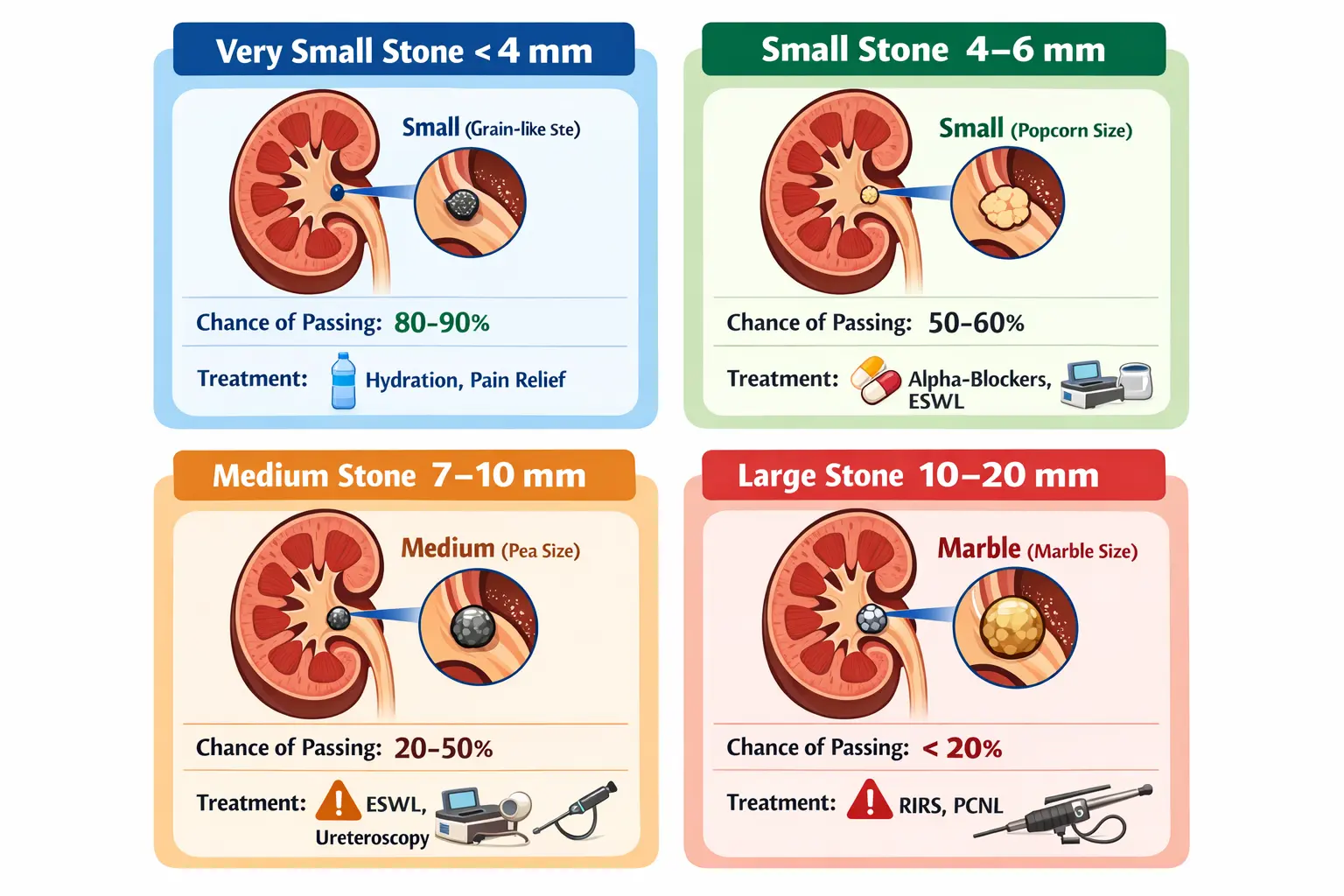
Kidney stone size (in millimeters) is the most important factor that decides symptoms, chances of natural passage, and the type of treatment needed. Stones can range from tiny sand-like particles to large stones that require surgery.
What Are Kidney Stones?
Kidney stones are hard mineral crystals formed when urine becomes too concentrated with substances like calcium, oxalate, or uric acid. They may stay in the kidney or move into the ureter and bladder, where they can cause severe pain by blocking urine flow.
Kidney Stone Size Chart (mm) and Treatment
< 4 mm (Very Small)
Chance of passing naturally: 80–90%
Symptoms: Mild or no pain, slight burning while urinating
Treatment: Fluids, pain medicines, observation
4–6 mm (Small)
Chance of passing: 50–60%
Symptoms: Intermittent back or lower abdominal pain, blood in urine
Treatment: Hydration, alpha-blocker medicines, ESWL if stuck
7–10 mm (Medium)
Chance of passing: 20–50%
Symptoms: Strong wave-like pain, nausea, difficulty urinating
Treatment: ESWL or ureteroscopy with laser
10–20 mm (Large)
Chance of passing: < 20%
Symptoms: Severe continuous pain, urine blockage, infection risk
Treatment: Ureteroscopy, RIRS, or PCNL
> 20 mm (Very Large)
Chance of passing: Almost 0%
Symptoms: Intense pain, low urine output, fever if infection
Treatment: PCNL (keyhole kidney surgery), rarely open surgery
Symptoms by Stone Size
Small stones: Mild flank pain, burning urine, may pass unnoticed
Medium stones: Severe colicky pain radiating to groin, blood in urine
Large stones: Constant intense pain, reduced urine flow, fever or chills if infection develops
How Doctors Measure Stone Size
Ultrasound: Initial screening
CT Scan (NCCT KUB): Most accurate for size and location
X-ray: Useful for calcium stones and follow-up
When to See a Doctor Urgently
Severe or persistent pain
Fever or chills
Difficulty or inability to pass urine
Visible blood in urine
Stone size greater than 6–7 mm
A kidney stone size chart in mm helps predict whether a stone will pass naturally or need treatment. Small stones (<6 mm) usually pass with medicines and fluids, while larger stones often require procedures like ESWL, ureteroscopy, RIRS, or PCNL. Early imaging and size-based management prevent complications and protect kidney function.


