
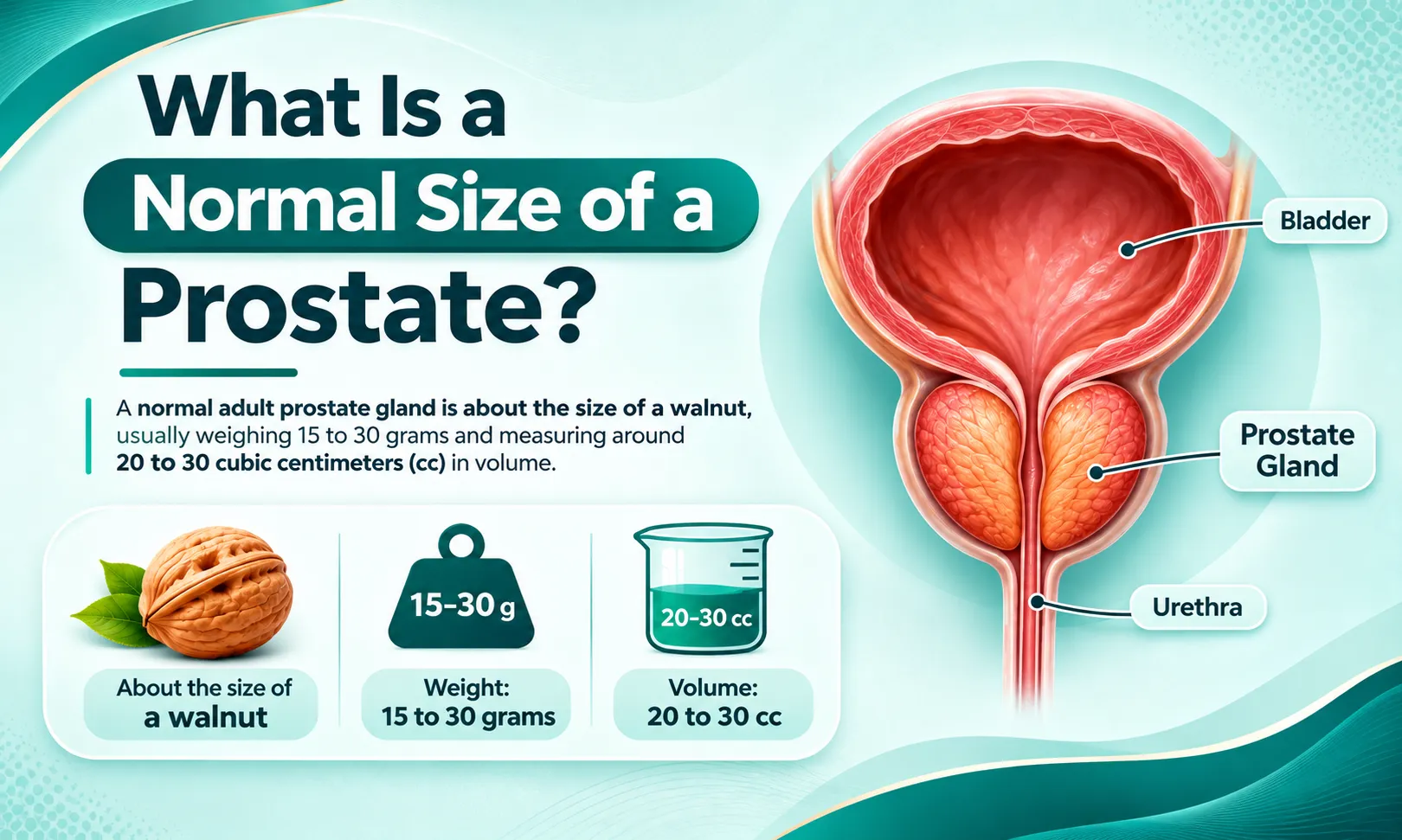
The prostate is a small, walnut-sized gland that plays an important role in male reproductive health. A normal adult prostate usually weighs 15–30 grams and measures around 20–30 cc in volume.
Its size may gradually increase with age, but enlargement does not always indicate a health problem. In this blog, we will discuss normal prostate size, age-related changes, causes of enlargement, symptoms, and treatment options.
What Is the Prostate Gland and What Does It Do?
The prostate is a tiny walnut-like gland that exists in men only. This gland is situated directly beneath the bladder and envelops the top portion of the urethra that allows for the excretion of urine from the body.
Its primary purpose is to provide a certain liquid that becomes a constituent of the seminal fluid and assists in nourishing and transporting sperm cells.
Since the urethra goes through the prostate, the enlargement of this gland may put pressure on it and affect the natural process of urine flow.
What Is the Normal Size of a Prostate?
"It is normally expected that the normal size of the prostate in a healthy adult male should be similar to that of a walnut. In fact, the average weight of the prostate is normally 15-20 grams and the volume averages 20-25 cc.
Nevertheless, there is some variation in prostate size across different males. Prostate size may differ based on age, genes, hormones and individual body type.
A slightly enlarged prostate as compared to the average size does not necessarily mean a disease. There are other considerations taken into account by doctors, including symptoms of urination and test results.
What Is the Normal Prostate Size in mm and cc?
"When a doctor performs an ultrasound, the prostate's normal size in mm is usually measured in three dimensions: width, height, and length. These measurements help calculate the total prostate volume."
The approximate normal prostate measurements are:
If you are looking for the normal size of the prostate in males in mm, these measurements provide a general reference for understanding your ultrasound report.
These are approximate reference measurements, and slight variations are common.
What Size of Prostate Is Considered Dangerous?
There is no fixed prostate size that is considered dangerous for every man. A prostate volume above approximately 30 cc is often considered enlarged, but this does not automatically mean that it is harmful or requires surgery.
Some men with a significantly enlarged prostate may have very few urinary symptoms, while others with only mild enlargement may experience difficulty passing urine. Therefore, prostate size alone cannot determine how serious the condition is.
A urologist considers prostate size along with urinary symptoms, urine flow, the amount of urine left in the bladder after urination, and any effect on the bladder or kidneys.
An enlarged prostate may become a serious concern if it leads to complications such as:
Difficulty emptying the bladder or urinary retention
Repeated urinary tract infections (UTIs)
Bladder stones
Blood in the urine
Bladder damage or kidney problems
If you are unable to pass urine at all, seek immediate medical attention. Blood in the urine or fever and chills along with urinary symptoms also require prompt medical evaluation.
The right treatment depends on the prostate size, symptoms, and test results. A urologist can determine whether regular monitoring, medication, or a procedure is needed.
Does Prostate Size Change With Age?
Yes, the prostate does go through changes in size with aging in a male person. With puberty, the hormonal changes lead to prostate enlargement and become full grown at the age of about 20.
From about 25 years on, a second period of prostate enlargement may occur. But the rate at which it enlarges varies from one person to another.
Some common signs of prostate changes in relation to age include:
Age 20-30: Prostate is of similar size to adulthood.
Age 40-50: Prostate enlargement begins gradually in some people.
Age 50-60: Prostate enlargement is common among men.
Above age 60: The possibility of prostate enlargement increases.
But age alone is not a factor that determines the health issue of prostate enlargement.
What Causes the Prostate to Become Enlarged?
There are various factors that could make the prostate enlarge. These include:
1. Benign prostatic hyperplasia (BPH): This refers to the non-malignant enlargement of the prostate which occurs as people age. It could result in the compression of the urethra and impact urine flow.
2. Prostatitis: This is inflammation and/or infection of the prostate which causes swelling, pain in the pelvis and difficulty urinating.
3. Prostate cancer: Malignant growth of cells in the prostate which affects the functioning of the prostate. Enlargement of the prostate, however, does not necessarily mean cancer.
The underlying reason can be established by the urologist.
What Are the Symptoms of an Enlarged Prostate?
The problem with an enlarged prostate is that it can press on the urethra, making the passage of urine difficult. Symptoms experienced by patients suffering from enlarged prostate include:
Increased need to urinate, especially at night
Trouble starting to urinate
Interrupted or weak flow of urine
Dribbling after urination
Feeling of incompletely emptied bladder
Constant urge to urinate
Difficulty passing urine
All men do not necessarily experience these symptoms due to enlarged prostate. In addition, the severity of urinary problems does not necessarily depend on the size of the prostate.
How Is Prostate Size Measured?
A urologist can prescribe certain tests to determine the size of the prostate and its general condition.
Some commonly used procedures include:
Ultrasound: Measurement of the size of the prostate gland and its volume calculation.
Transabdominal Ultrasound: Visualization of the prostate gland through the lower abdomen, generally done in a fully distended bladder.
Transrectal Ultrasound: Measurement of the prostate gland using an ultrasound probe inserted into the rectum.
MRI: Detailed imaging of the prostate gland and recommended in cases where further diagnosis is needed.
Other procedures can include PSA blood test, urinalysis, or digital rectal exam based on the patient's complaints.
When Should You Consult a Urologist?
You are advised to see a urologist when you notice any abnormal urine behavior, including nocturia, poor urine stream, problems emptying the bladder, and painful urination.
The presence of blood in your urine needs medical evaluation as well. These symptoms shouldn’t be overlooked, no matter how near your prostate is to the normal size.
In case you find yourself unable to urinate, see a doctor immediately.
Conclusion
Knowing the standard size of the prostate gland will enable one to know how his prostate gland is performing and notice any abnormalities. A grown-up prostate gland is usually 20-25 cc in size, even though the size may differ depending on many other factors.
Enlargement of the prostate does not necessarily mean cancer, and does not always require surgical procedures; however, signs such as increased urge to urinate, reduced urine flow and inability to empty the bladder need attention.
For those who have problems with the enlargement of their prostate glands or with their urination processes, it would be wise to consult Dr. Anuj Arora, one of the best urologists in Greater Noida.
Frequently Asked Questions
1. What is the normal size of the prostate in males?
The normal prostate gland size is roughly that of a walnut with a size of 20-25 cc in volume and weighing between 15-20 grams.
2. What is normal prostate volume in cc?
The normal prostate volume of a healthy male is 20-25 cc. Normal measurement depends on age among other factors.
3. What is the normal size of the prostate in males in mm?
Normal dimensions include 37.5-40 mm in width, 25-30 mm in height and 31-38 mm in length.
4. What age does the prostate start growing?
Gradual prostate growth starts at age 25. Enlargement of the gland becomes noticeable from 40-50 years.
5. Does an enlarged prostate always indicate cancer?
No. Prostate enlargement is mostly due to benign prostatic hyperplasia. The enlargement is non-cancerous.


