
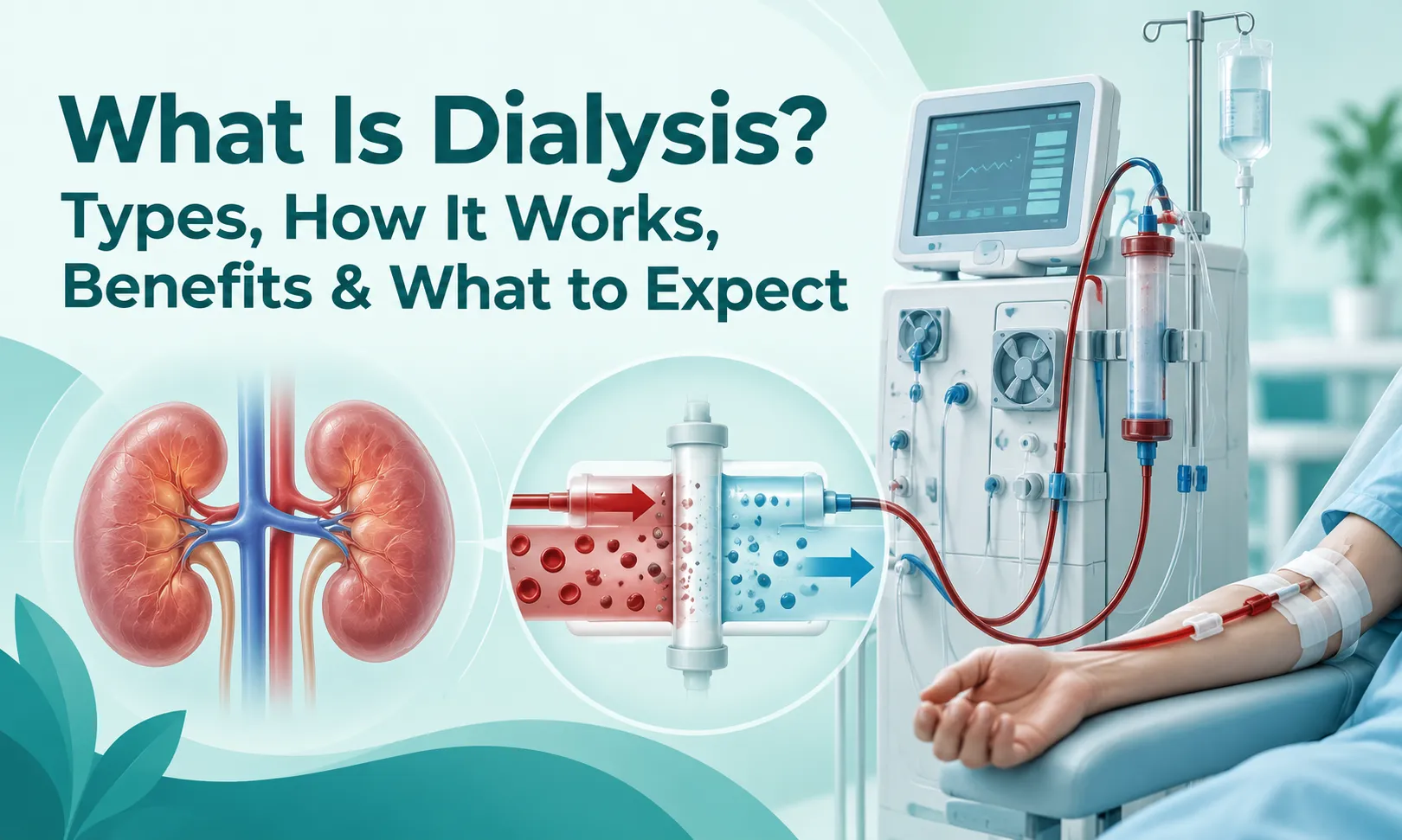
Dialysis is a medical treatment that filters waste, toxins, and extra fluid from the blood when the kidneys are not working properly. Healthy kidneys normally remove waste and excess water from the blood, but when kidney function becomes severely reduced, dialysis may be needed.
Depending on the cause of kidney failure, dialysis may be temporary or long-term. In this blog, we will discuss its types, how it works, what to expect, possible side effects, and dialysis vs. kidney transplant.
What Is Dialysis?
Dialysis is a method that replaces some of the functions of the kidney filtration system. It helps eliminate waste from the blood and helps the body with its fluid and mineral balance by removing excess fluids.
When the kidneys are not performing at the required level dialysis can help provide some of the functions that the kidneys normally perform. However, this does not mean that dialysis is a cure for kidney failure.
When Is Dialysis Needed?
When body waste and excess fluid cannot be filtered by the impaired kidneys, dialysis becomes necessary.
Dialysis may become necessary for:
Severe kidney failure
Advanced chronic kidney disease
Some cases of acute kidney injury
Waste product buildup or excess fluid buildup
Some serious side effects of severely depleted kidney function
In cases of acute kidney disease, dialysis is sometimes necessary to support the kidneys as they recover, but in advanced chronic kidney failure, dialysis is a long-term support measure until a kidney transplant is possible.
What Are the Types of Dialysis?
There are two main types of dialysis: haemodialysis (hemodialysis) and peritoneal dialysis.
1. Haemodialysis
Haemodialysis uses a machine and a special filter called a dialyser. Blood is taken from the body through suitable vascular access and passed through the dialyser. The filter removes waste products and excess fluid before the cleaned blood is returned to the body.
Many people receive haemodialysis at a dialysis centre several times a week. Home haemodialysis may also be an option for some patients. The exact schedule and duration depend on individual medical needs.
2. Peritoneal Dialysis
Peritoneal dialysis uses the lining of the abdomen, called the peritoneum, as a natural filtering membrane.
A catheter is placed into the abdominal cavity, through which dialysis solution is introduced. Waste products and excess fluid move from the blood into this solution. After a prescribed period, the used fluid is drained and replaced with fresh solution.
Peritoneal dialysis can be performed manually during the day or with a machine, known as automated peritoneal dialysis, usually during sleep.
How Does Dialysis Work?
While they differ in process, both types of dialysis have the same overarching goal — to remove substances impaired by failing kidneys.
In haemodialysis, blood is removed, circulated through an external dialyser to have waste and excess fluid filtered, before being returned to the body. In peritoneal dialysis the body's abdominal cavity is used with the peritoneal membrane as the filtering membrane.
The treatment schedule is dependent upon the patient's kidney function and their overall health, as well as the type of dialysis.
What Can You Expect During Dialysis?
There are changes to daily routine when starting dialysis. Regular treatment scheduling may require changes to diet, fluid, and medication control as per the recommendations of the healthcare team.
Some individuals experience symptoms that include fatigue, lightheadedness, muscle cramps and nausea before and during haemodialysis sessions. You may also experience infection symptoms in the abdomen and around the catheter during peritoneal dialysis. Report symptoms that are concerning or new to your healthcare team.
With adequate care, it is possible that dialysis patients continue to work, remain active and social and maintain their family commitments.
Is Dialysis a Permanent Treatment?
Not necessarily. The length of time for dialysis depends on the reason it's needed.
Some people may need dialysis for only a short time if they have a kidney injury that is reversible. LLong-termdialysis is usually required for permanent kidney failure. A kidney transplant can be an option for some people as well. Not everyone qualifies for a kidney transplant.
Dialysis vs Kidney Transplant
Managing kidney failure can be done using either dialysis or kidney transplantation. In dialysis, part of the work of the kidney is carried out by a machine or the peritoneum. A kidney transplantation involves surgery to put a donor's healthy kidney in the recipient's body.
Some patients may need to go through dialysis as they wait for a kidney transplant. The choice of either will depend on the kidney's function, the patient's general health and the patient's preference.
Conclusion
Dialysis helps remove waste and excess fluid from the blood when the kidneys are no longer able to perform these functions properly. The two main types are hemodialysis and peritoneal dialysis, and the most suitable option depends on kidney function, overall health, lifestyle, and individual medical needs.
For some patients, dialysis may be needed only temporarily, while others may require long-term treatment or may later be considered for a kidney transplant. If you have advanced kidney disease, worsening kidney function, or concerns about urinary and kidney health, timely medical evaluation is important.
For specialist guidance related to kidney and urinary conditions, you can consult Dr. Anuj Arora, Best Urologist in Greater Noida, for appropriate evaluation and treatment planning.
Frequently Asked Questions About Dialysis
1. How long can a person live on dialysis?
There is no fixed duration. Many people live for years on dialysis, depending on their age, overall health, kidney condition, heart health, treatment adherence, and other medical factors.
2. How many times a week is dialysis usually needed?
The frequency depends on the type of dialysis and the patient’s medical condition. Many people receiving hemodialysis require treatment several times a week, while peritoneal dialysis is usually performed more frequently according to a prescribed schedule.
3. Is dialysis painful?
Dialysis itself is generally not considered painful, although needle insertion for hemodialysis may cause brief discomfort. Some patients may experience cramps, headaches, weakness, or low blood pressure during or after treatment.
4. Can kidney function improve after starting dialysis?
In some cases of acute kidney injury, kidney function may recover enough for dialysis to be stopped. In advanced chronic kidney disease, dialysis is usually required long-term unless kidney transplantation becomes possible.
5. Can dialysis be stopped once it has started?
This depends on why dialysis was started. Temporary dialysis may be stopped if kidney function recovers sufficiently. Patients with permanent kidney failure should not stop dialysis without medical advice.
6. Can a person urinate normally while on dialysis?
Yes, some people continue to produce urine after starting dialysis. However, urine output may gradually decrease as kidney function worsens.
7. What foods should dialysis patients avoid?
Dietary restrictions vary from person to person. Some patients may need to limit sodium, potassium, phosphorus, or fluids. A doctor or renal dietitian can recommend a diet based on blood tests and the type of dialysis.
8. How much water can a dialysis patient drink?
Fluid intake depends on urine output, swelling, blood pressure, dialysis type, and overall health. Patients should follow the fluid limit recommended by their healthcare team rather than using a fixed amount.
9. What are the common side effects of dialysis?
Possible side effects may include tiredness, muscle cramps, low blood pressure, dizziness, nausea, itching, or problems related to dialysis access. The type and severity of side effects vary between patients.
10. Can dialysis patients continue working?
Many people are able to continue working, studying, travelling, and carrying out normal daily activities. Some adjustments may be needed around dialysis schedules and energy levels.
11. Can dialysis patients travel?
Yes. Travel is often possible with advance planning. Patients receiving hemodialysis may need to arrange treatment at a dialysis centre at their destination, while people on peritoneal dialysis may need to organise supplies beforehand.
12. Does dialysis completely replace kidney function?
No. Dialysis replaces only some of the filtering functions of the kidneys. It does not fully perform all the hormonal and metabolic functions of healthy kidneys.
13. Which is better: hemodialysis or peritoneal dialysis?
Neither method is automatically better for everyone. The appropriate choice depends on medical condition, lifestyle, kidney function, home support, and personal preferences.
14. Can a patient receive a kidney transplant after being on dialysis?
Yes. Many patients undergo dialysis while waiting for a suitable kidney transplant. Eligibility for transplantation depends on overall health and a detailed medical evaluation.
15. When should a dialysis patient contact a doctor urgently?
Medical attention may be needed for severe breathlessness, chest pain, high fever, significant swelling, confusion, persistent vomiting, very low blood pressure, or signs of infection around a dialysis catheter or access site.


