
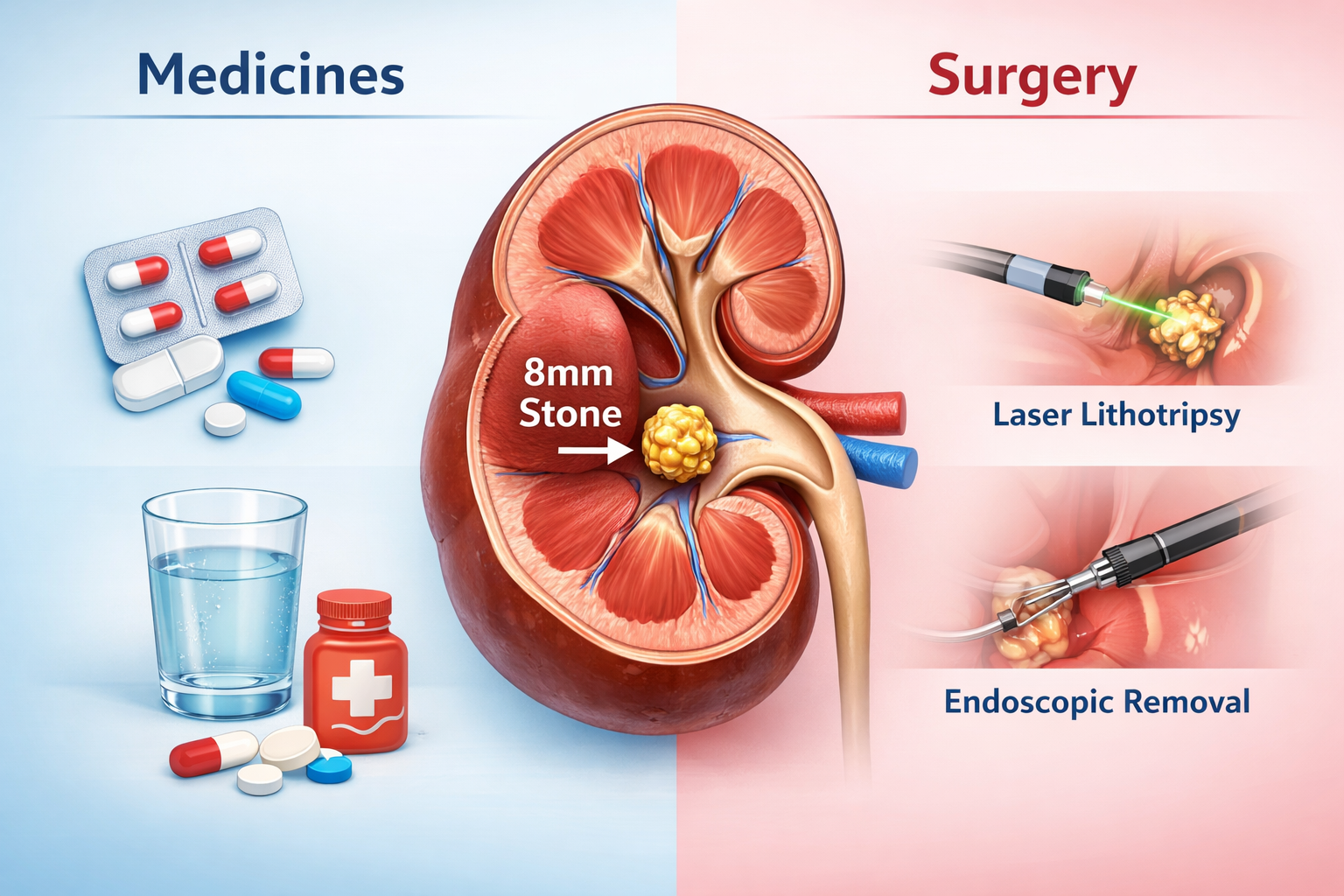
Being detected as having a kidney stone measuring 8mm usually results in a very confused look on the patients' faces. Patients usually ask questions like: "Is an 8mm kidney stone dangerous? Can it pass on its own? Are medications enough, or will I need surgery?"
8mm kidney stone can be considered more or less moderate in size. Yes, it's smaller than a 9 to 10 mm stone, but it still runs the risk of getting stuck in the ureter, causing severe pain, or even an infection if it isn't treated properly. Treating it shouldn't be too delayed; complications will arise.
This blog will provide answers for what to do regarding the medical management of an 8mm kidney stone versus surgical management, and what options are the best in terms of safety and efficacy, under the guidance of one of the prominent Best Urologists in Greater Noida, Dr. Anuj Arora.
Is 8mm Kidney Stone Dangerous?
When patients have kidney stones, one of the first things they want to know is, are 8mm kidney stones dangerous?
8mm kidney stone does not kill you right away, but it could become dangerous if you don’t treat it. This size stone could get stuck in the ureter, which could completely or partially block the flow of urine from the kidney to the bladder.
It could cause:
Severe and recurring pain
Swelling of the kidney
Infection of the urinary tract
Gradual decline in kidney function
Because of all these things, urologists have to keep an eye on that 8mm stone and instead of waiting it out, they suggest active treatment.
8mm Kidney Stone Symptoms
You can often tell when someone passes an 8mm stone. They are painful and annoying. The severity depends on whether the stone is stuck, obstructioned or just sitting there.
Here are some common symptoms:
Sharp, back or side pain
lower abdomen pain or groin
Urine blood
Nausea/Vomiting
Burning or discomfort when urinating
Interrupted urine flow
Although symptoms may come and go, if pain continues and is getting worse, likely that the stone is not passing on its own.
Can an 8mm Kidney Stone Pass Naturally?
One of the most asked questions of all time is can an 8mm kidney stone pass on its own?
The answer is sometimes, but the answer isn't the best.
With an 8mm stone, the chances of it passing are significantly lower than those of the smaller stones.
Some stones can pass though it is not common but these things may aid in passing:
The stone is located near the bladder
The ureter is not tight
The stone is smooth
Most of the time 8mm kidney stones do get stuck which can lead to pain, diseased kidneys, or even an infection. It isn't good to just wait for the stone to pass.
How to Treat 8mm Kidney Stone
How do urologists decide how to treat an 8mm kidney stone?
Here are some factors that can help determine:
Location and size of the stone
Severity of symptoms
Swelling or blockage of the kidneys
Infection
General kidney function
Treatments available can typically be categorized as:
Medical treatment
Surgical treatment
The main goal is to do more than alleviate the pain. We want to completely and safely remove the stone to prevent additional complications.
When Is 8mm Kidney Stone Surgery Required?
8mm kidney stone surgery is recommended when:
There is severe or recurring pain
You have a stone that doesn’t pass during follow-up imaging
You have an obstruction of the kidney or there is swelling
Infection or fever has occurred
There is no relief even after pain medications
Modern surgical techniques are fast and painless. Procedures like ureteroscopy and laser stone removal allow fast recovery and complete stone removal without the need for large incisions.
Long term pain or kidney damage is likely if surgery is necessary, and there is a delay.
Medicines vs Surgery for 8mm Kidney Stone – What Works Better?
This is the most important decision point for patients undergoing 8mm kidney stone treatment.
Medicines vs Surgery for 8mm Kidney Stone
Medicines may help reduce pain and ureter spasms, but they cannot dissolve or reliably remove an 8mm stone. Surgery provides definitive treatment and protects kidney function.
Kidney Stone Treatment in Greater Noida
Getting advanced kidney stone treatment in Greater Noida on time is critical to avoid any issues down the road. Thanks to state-of-the-art imaging technology, minimally invasive techniques, and the best urologist care, people can recover quickly and have long-term relief.
Some other treatments by specialists are also aimed at avoiding stone recurrence by assessing each patient's case individually as well as offering dietary guidance and follow-up appointments.
Conclusion
An 8mm kidney stone should not be ignored. You may be able to pass some stones naturally; however, the pain with these stones can increase, along with the risk of infection and kidney damage, if these stones are ignored and not treated. Medications can provide relief, but they are not successful with complete stone clearance.
Fortunately, timely surgical intervention has been the best approach for most patients. If you are experiencing symptoms of 8mm kidney stones, the best Urologist in Greater Noida is Dr. Anuj Arora. He has years of experience and provides patients with the most accurate diagnosis and best treatment options available.
You will have minimal long-term kidney damage, have a fast recovery, and the recovery will be safe.
Also Read:


