
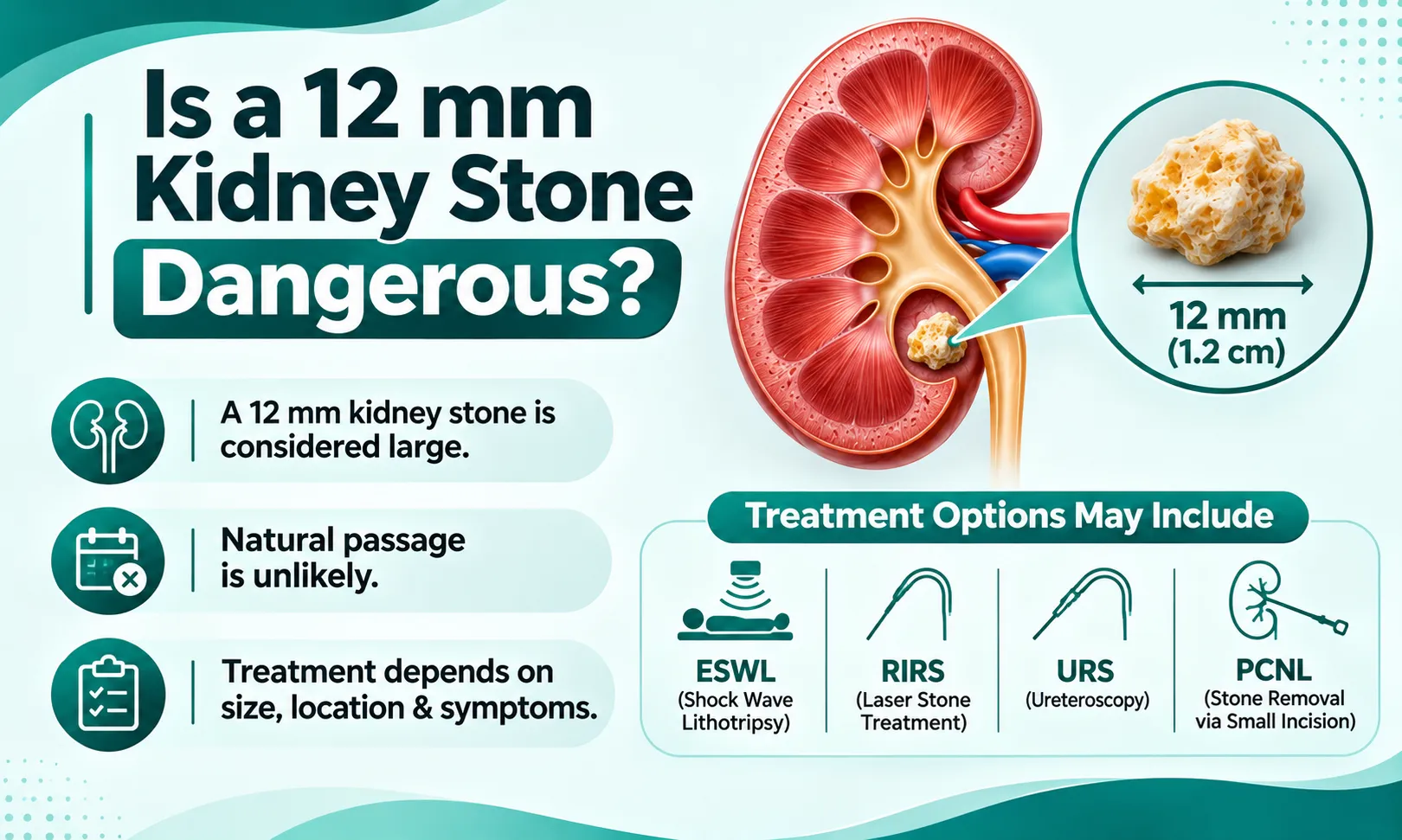
A 12 mm kidney stone is considered relatively large and is less likely to pass naturally through the urinary tract, especially if it enters the ureter. Depending on its location, it may cause severe pain, block urine flow, or lead to complications such as kidney swelling and infection.
But is a 12 mm kidney stone always dangerous? What symptoms should you watch for, and which treatment options are available? In this blog, we will discuss the risks, chances of natural passage, possible complications, and treatment options for a 12 mm kidney stone.
What Is a 12 mm Kidney Stone?
A kidney stone is formed when mineral salts in the urine join together to create hard deposits in the kidney. Stones have varying sizes and either stay in the kidney or travel down to the ureter, which is the organ that transports urine to the bladder.
A 12-millimeter kidney stone is about 1.2 centimeters in diameter and is considered quite large compared to smaller kidney stones. Smaller stones can be passed easily through the urine, but passing this large-sized stone will require help from the medical community.
Its location, formation and presence of obstruction to the flow of urine all affect the necessary treatment.
Is a 12 mm Kidney Stone Dangerous?
Yes, a 12mm kidney stone could cause problems, especially if it enters the ureter and prevents normal passage of urine. With regard to its size, it may not move naturally and may need to be treated medically.
Some possible dangers include:
Obstruction of Urine Flow: The stone might cause obstruction of urine passing from the kidney to the bladder.
Hydronephrosis: Obstructed urine will collect in the kidney and result in swelling.
Infection of the Kidney: Obstruction of urine might lead to infection.
Damage to the Kidney: Obstruction might lead to impairment of kidney functions.
However, a 12mm stone doesn’t always cause immediate problems. If the stone stays in the kidney without obstructing or causing other symptoms, a urologist can observe it.
Can a 12 mm Kidney Stone Pass Naturally?
It is unlikely for a kidney stone that has reached the size of 12 mm to pass naturally, especially when it migrates into the ureter because it is a narrow passage through which it may get stuck and cause pain and blockage.
Factors that determine the likelihood of the natural passage include:
Size of the Stone: The likelihood is higher with smaller stones compared to larger stones.
Location of the Stone: Stones located near the bladder may have a higher chance of passing naturally compared to those in the upper ureter.
Shape of the Stone: It is possible that stones shaped differently from each other might behave differently.
Urological Structure: The ureter diameter plays a significant role in stone migration.
Some drugs may assist in passing certain types of ureteral stones in specific individuals; however, no drugs can ensure that a 12 mm stone will pass naturally.
12 mm vs 9mm Kidney Stone: What Is the Difference?
Both 9mm and 12 mm kidney stones are considered relatively large, but their chances of passing naturally are different.
A 9 mm stone in the kidney might not give any symptoms, but if the stone travels into the ureter, it will cause serious pain. For a 12 mm stone, there is also a low possibility of spontaneous passage. In this case, both scenarios need to be diagnosed properly by a urologist.
What are the Symptoms of a 12 mm Kidney Stone?
Some kidney stones do not show any symptoms as long as the stone stays in the kidney.
But when the stone starts moving or obstructs the urine flow, it might lead to:
Severe pain in the back or side area.
Pain that radiates from the back to the abdomen or groin area.
Bloody urine.
Burning feeling while urinating.
Increased urge to urinate.
Vomiting and nausea.
Difficulty with urination.
These symptoms can vary in intensity according to the stone position and blockage. Symptoms of kidney stones along with fever and chills, might mean an infection.
What Happens If a 12 mm Kidney Stone Is Left Untreated?
Neglecting a 12 mm kidney stone could lead to further complications, particularly if there is a blockage of urine flow.
Some potential complications include:
Chronic Urinary Obstruction: The kidney stone could cause urine not to drain.
Hydronephrosis: Fluid retention caused by continued blockage of urine.
Recurrent Infection: Urine blockage might cause recurrent UTIs.
Compromised Kidney Function: Blockage might harm kidney function due to continued damage to kidney tissue.
Pain: Recurring pain due to the stone.
While not all kidney stones require removal immediately, monitoring and treatment can be very helpful for maintaining the health of the kidney.
How Is a 12 mm Kidney Stone Diagnosed?
A urologist may use different tests to determine the exact size, position, and impact of the stone on the functions of the kidney.
The following diagnostic tests may be used:
An ultrasound: Useful in detecting kidney stones and the swelling of the kidneys.
A CT scan: Gives useful information concerning the size, position and density of the stone.
Urinalysis: It is done to test for blood, infection, and other abnormal conditions.
Blood test: Helps evaluate the functioning of the kidney and presence of infections.
What Are the Treatment Options for a 12 mm Kidney Stone?
The treatment process is based on such criteria as stone localization, its density, symptoms of the patient and kidney condition. A urologist might suggest one of the following options:
1. RIRS (Retrograde Intrarenal Surgery)
This is a minimally invasive technique applied to treat kidney stones. It is performed using a flexible scope inserted into the kidney through the urinary tract. Using a laser, the doctor breaks the stone into small pieces to remove or excrete with urine.
2. PCNL (Percutaneous Nephrolithotomy)
This procedure involves creating an opening in the back to access the kidney and extract the stone. It is indicated for bigger and more complex stones according to their location.
3. URS (Ureteroscopy)
URS is widely used when a kidney stone enters the ureter. The urologist uses a narrow scope inserted through the urinary tract to access the stone and either break it with laser energy or remove.
4. ESWL (Extracorporeal Shock Wave Lithotripsy)
In this treatment procedure shock waves created externally are used to destroy the kidney stones. This treatment might be applied to some patients depending on stone characteristics. In some cases the treatment may be repeated several times.
When Should You See a Urologist?
Consult a urologist if you experience persistent back pain, blood in the urine, difficulty passing urine, or repeated urinary infections. Seek immediate medical attention if you develop fever, chills, severe pain, repeated vomiting, or an inability to urinate. Early evaluation can help prevent complications and protect kidney function.
Conclusion
A 12 mm kidney stone is considered large and is unlikely to pass naturally, especially when located in the ureter. If left untreated, a stone causing urinary blockage may lead to kidney swelling, infections, and damage to kidney function. However, not every 12 mm kidney stone requires the same treatment.
The treatment depends on the stone's location, size, density, symptoms, and overall kidney health. Options such as ESWL, RIRS, URS, or PCNL may be recommended depending on the patient's condition. If you have a large kidney stone, consult Dr. Anuj Arora, one of the best urologists in Greater Noida, for proper diagnosis and treatment guidance.
Frequently Asked Questions
1. Is a 12 mm kidney stone large?
Yes, a 12 mm kidney stone is considered large. It rarely passes on its own and will require treatment depending on its position and symptoms.
2. Can a 12 mm kidney stone pass without surgery?
It will be very difficult for this kidney stone to pass on its own. Some individuals might require surgical intervention to shatter or remove the stone.
3. Is a 9mm kidney stone harmful?
A 9mm kidney stone can cause pain and even infections. The risks associated with a 9 mm kidney stone are determined by its position.
4. What surgery is required for a 12 mm kidney stone?
A RIRS, PCNL, URS or ESWL is suggested based on the patient's condition and the location of the stone.
5. How long can one live with a 12mm kidney stone?
This is not fixed. Depending on the case, some stones can be monitored while others should undergo a procedure immediately.
Related blogs
Is 7mm Kidney Stone Dangerous? Symptoms, Risks, and Treatment Options
Where Does Kidney Stone Pain Occur? Symptoms, Pain Location & Relief
Can a 9mm Kidney Stone Pass Through Urine? What You Need to Know


