
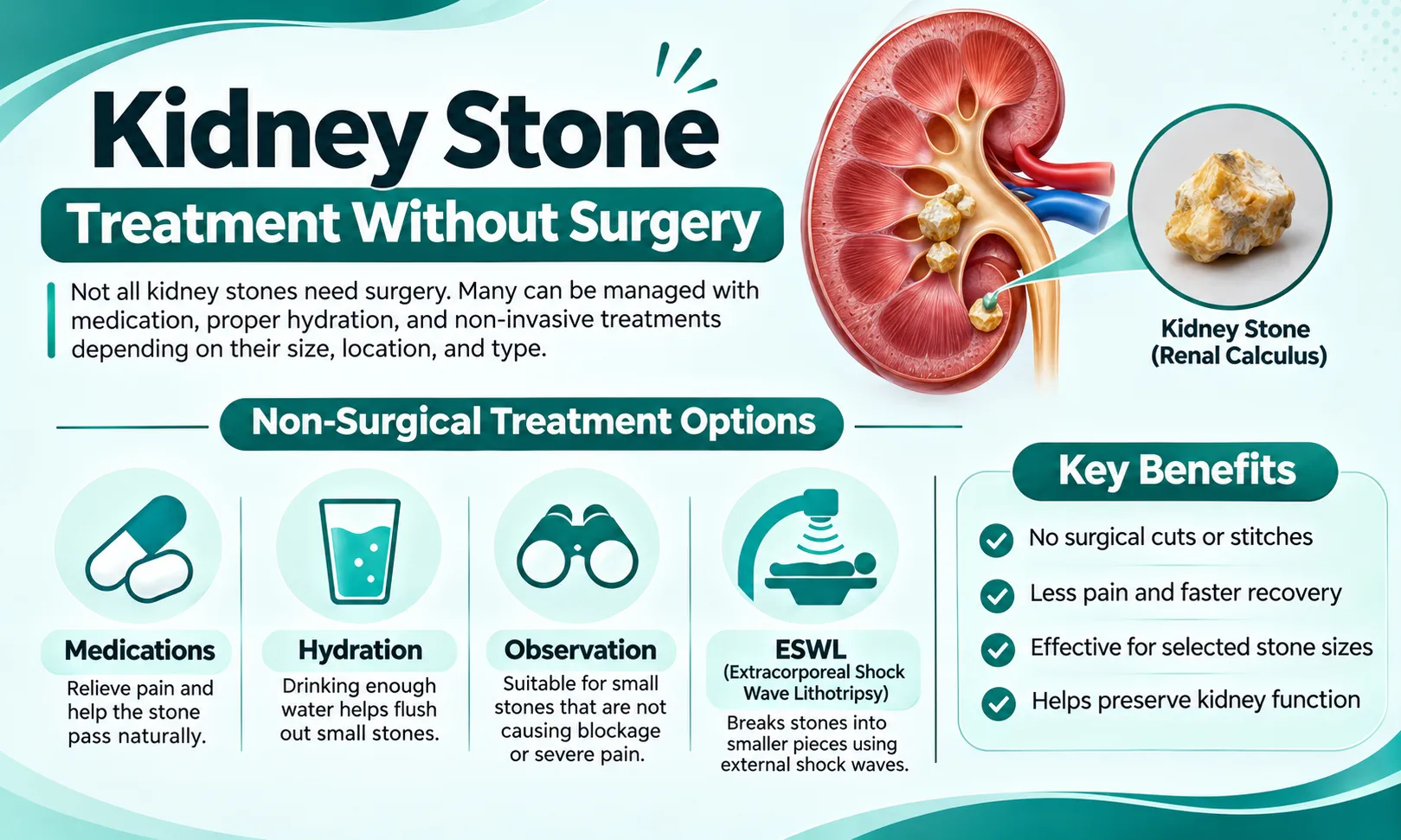
Kidney stones can cause significant pain and discomfort, but not every stone requires surgery for removal. Depending on the size, location, and type of stone, some kidney stones may pass naturally with the help of prescribed medicines and adequate fluid intake. Other stones may be treated using non-invasive procedures such as Extracorporeal Shock Wave Lithotripsy (ESWL), which breaks stones into smaller fragments without making surgical cuts.
Choosing the right treatment depends on the patient's condition and whether the stone is causing pain, blockage, or affecting kidney function. In this blog, we will explore different kidney stone treatment options without surgery, including medication, hydration, natural stone passage, and treatment approaches for 5 mm, 10 mm, and 12 mm kidney stones.
What Are Kidney Stones?
Kidney stones are crystalline collections of salts and other materials formed in the kidneys from substances present in urine that become too concentrated. These vary in size and may either be located within the kidneys or even travel through the ureter to the bladder.
Calcium oxalate, uric acid, and struvite are some common kinds of kidney stones. Based on size and positioning, kidney stones could cause such symptoms as back pain, blood in urine, discomfort in urination, nausea and urinary difficulty.
Is It Possible to Treat Kidney Stones Without Surgery?
Sure, there are instances where kidney stones do not require surgical removal. Some small stones might get flushed out through urination; in addition to this, some prescribed medications may help in dealing with pain and removing these stones.
There are situations when uric acid stones could also get dissolved through medications that alter the acidity level of urine. Another procedure that does not involve any cuts or incisions is Extracorporeal Shock Wave Lithotripsy (ESWL).
If the stones are large or are blocking the flow of urine, then procedures like RIRS, URS, and PCNL become necessary. It all depends on the nature of the stone.
Kidney Stone Treatment Without Surgery: Available Options
In accordance with the patient's condition, the following procedures might be recommended by a urologist to remove kidney stones without surgery.
1. Observation
For small stones that do not cause pain or obstruction of urine flow, observation instead of immediate treatment may be chosen. Imaging is required to track changes in the size and position of the stone.
2. Medicines
There are medications that will help alleviate the symptoms and assist in passing stones naturally.
Pain relievers will ease the pain.
Alpha-blockers such as tamsulosin might help some patients to pass stones in the ureter.
Potassium citrate might help dissolve uric acid stones by adjusting the urine acid levels.
It is necessary to take these medicines only under a doctor's recommendation
3. Sufficient Fluid Intake
Adequate intake of fluid ensures that there is constant urine flow, which may help the natural passage of small stones. Fluids also aid in dilution of urine to minimize chances of formation of new stones.
But too much fluid intake will not compel a big stone to pass.
4. Extracorporeal Shock Wave Lithotripsy (ESWL)
ESWL is an extracorporeal treatment method that employs use of shock waves externally to fragment kidney stones.
It may be recommended to certain patients based on the size, location and hardness of the stones.
Can Kidney Stones Pass Naturally Based on Their Size?
The chances of passing a kidney stone naturally depend largely on its size and location. Smaller stones generally have a better chance of passing through the urinary tract without a procedure.
Stone location also matters. Stones located closer to the bladder may have better chances of passing than those in the upper ureter. However, these are general estimates, not guarantees.
5 mm Kidney Stone Treatment Without Surgery
A 5mm kidney stone can pass naturally, especially if it is situated in the ureter. It might be suggested for a patient with a 5 mm kidney stone to use the approach of watching and waiting, drinking enough fluid, and taking pain medication.
Sometimes, there is a possibility of using medical expulsive therapy to ease the ureter and promote natural stone passage. Follow-up is necessary to make sure whether the stone passes and there is no obstruction caused by it.
10 mm Stone in Ureter Treatment
Treatment of a 10mm stone in the ureter is less likely to pass naturally than in the case of smaller stones. It is determined by its position, symptoms and the fact whether the stone is causing any obstruction.
There is a chance of trying medications and ESWL in some cases to break the stone. In other situations, when it is unlikely to pass naturally or cause any obstruction or pain, ureteroscopy (URS) might be required.
12 mm Kidney Stone Treatment Without Surgery
A kidney stone measuring 12 mm is considered to be large, and its natural passage out of the body is unlikely unless it is in the ureter. Yet, 12 mm kidney stone treatment without surgery can be attempted under some circumstances via ESWL.
ESWL refers to an external shock wave technique that crushes the stone into smaller pieces. It requires the stone's location, density and composition. In some instances, repeat treatment may be required.
If ESWL cannot be performed or fails, other methods like RIRS and PCNL can be considered by the urologist for the removal of the stone. Certain non-obstructing stones inside the kidney can be left untreated.
When Is Surgery Necessary for Kidney Stones?
Surgeries and endoscopies may be required for a kidney stone that is too big to pass naturally or one that causes problems like:
Obstruction of urine
Pain
Recurring urinary infections
Inflammation of the kidney or reduced functionality of the kidney
If medicines and other treatments fail to work
An infected and blocked kidney needs immediate medical help. If this happens, then it may become hazardous if there is a delay in treatment.
How to Prevent Kidney Stones Naturally?
A few healthy behaviors that can lower the risk of recurrence of kidney stones are as follows:
Consume adequate amounts of water throughout the day
Reduce salt intake
Reduce intake of excess animal proteins
Get sufficient dietary calcium
Limit high oxalate foods if suggested by your doctor
Maintain an optimal body weight through exercise
The diet should be customized according to the type of kidney stone and medical history of the person.
Conclusion
Kidney stones can sometimes be treated without surgery through observation, medication, adequate fluid intake, or ESWL in suitable cases. However, larger stones, especially those above 10 mm, are less likely to pass naturally and may require a medical procedure.
The right treatment depends on the stone's size, location, composition, and whether it is causing pain, blockage, or affecting kidney function. Early evaluation by a urologist can help determine the most suitable treatment.
If you are experiencing kidney stone symptoms, consult Dr. Anuj Arora, one of the best urologists in Greater Noida, for proper diagnosis and treatment guidance.
Frequently Asked Questions about kidney stone
1. Can there be any non-surgical ways to remove kidney stones?
Yes, small kidney stones may pass naturally with observation and prescribed medication. ESWL can also break certain stones into smaller fragments without making any surgical cuts.
2. Can there be any natural way of passing a 5 mm kidney stone?
Yes, a 5 mm stone may pass naturally, especially if it is located in the ureter. The chances depend on its position, shape, and the patient's urinary tract.
3. Is there any possibility of treating a 12 mm kidney stone without surgery?
Yes, selected 12 mm kidney stones may be treated using ESWL, which breaks stones using external shock waves. However, some patients may require RIRS or PCNL depending on the stone's size, location, and density.
4. What is the best treatment for a 10 mm stone in the ureter?
Treatment depends on the stone's location, symptoms, and whether it is causing an obstruction. Options may include medication, ESWL, or ureteroscopy (URS).
5. Can drinking water help remove kidney stones?
Drinking enough water increases urine flow and may help small stones pass naturally. However, water cannot dissolve or force out every kidney stone, especially larger ones.
6. How long does it take for a kidney stone to pass naturally?
The time varies depending on the stone's size and location. Some small stones may pass within a few days, while others can take several weeks. Medical follow-up is important to confirm that the stone has passed.
7. Can a 10 mm kidney stone pass naturally?
A 10 mm stone is less likely to pass naturally than a smaller stone, particularly if it is located in the ureter. A urologist may recommend ESWL, URS, or another suitable treatment based on the patient's condition.
8. Is ESWL a surgery or a non-surgical treatment?
ESWL is a non-invasive procedure that uses shock waves from outside the body to break kidney stones into smaller pieces. It does not require surgical cuts or incisions.
9. When does a kidney stone require surgery?
A procedure may be needed when a stone is too large to pass naturally, causes persistent pain or urinary obstruction, leads to repeated infections, or affects kidney function.
10. When should I seek immediate medical help for kidney stones?
Seek immediate medical attention if you experience severe pain with fever or chills, difficulty or inability to pass urine, or symptoms suggesting an infection. An infected and obstructed kidney requires urgent treatment.
Related blogs
Is 7mm Kidney Stone Dangerous? Symptoms, Risks, and Treatment Options
Where Does Kidney Stone Pain Occur? Symptoms, Pain Location & Relief
Can a 9mm Kidney Stone Pass Through Urine? What You Need to Know


